All posts by georgesinc

Eco-Communities & Community Self Build

This section of Making Lewes highlights a variety of different ways in which parts of towns, cities and urban fabric are given over to environmental and sustainably focused living, in ways which go beyond the individual home.

Eco-Districts and Eco-Housing are an approach to urban design, which integrate green elements right through the design of the site, including energy sources, transport, and food growing schemes. Although the number Eco-Districts remain small they continue to grow in different and diverse forms. Some of which are initiated by Government (mainstream), while others are more grass roots in organisation and origin.

The examples presented are both mainstream and non-mainstream, and come from Britain and continental Europe.

There are also several examples of Co-Housing, which are communities initiated and organised by their residents. Households are generally individual and self-contained while various aspects of the community are shared and managed together. Co-Housing is still small scale in Britain, while on some parts of the continent – such as Denmark – it has been a major part of the way people live.

Community Self-Build differs from Co-Housing, in that the buildings are built by those wanting to live in the completed homes. And although once completed communities of self-build can follow similar strategies for community organisation, this is not necessarily the case.

Click on the bellow tabs for examples of Eco-Communities, Eco-Districts & Co-Housing and Community Self-Build

The Federal Centre South Building – USA

Bang up to date, the 2013 US green buildings awards included the Federal Center South Building 1202  which re-claimed remarkably around 200,000 feet of structural timber and 100,000 feet of decking from the decommissioned non-historic WWII warehouse on the site.

According to the green awards citation, the team used “a phased demolition process, wood components were individually harvested from the warehouse. The team pulled nails, unfastened bolts, removed brackets and devices, trimmed out fractures, and sorted the wood before it was shipped to a local mill for structural grading and fabrication for use in the new building. To optimize the use of the available size the engineer suggested the use of composite design for the floor system.” Whatever else you think of the building this super reuse of timber is quite a feat.

Federal Center South

Rural Studio

Rural Studio  have been working with reused, reclaimed and found materials in the Southern US state of Alabama for several decades. Arguably their most iconic, reuse project is Mason’s Bend Chapel where car window screens make the perfect façade foil for this glass cathedral of the dispossessed. Check the rest of Rural Studio’s site for many other examples, old and new, of how architecture can make sublime virtues out of the art of reuse necessity.

mbcc_corner3_f_fulton

Newbern-Auburn-Rural-Studio_7p-1512-1


BioRegional

BioRegional, the social entrepreneurs behind BedZED and One Planet Living (including OneBrighton), have been one of the most active in initiatives to get Building Material Reuse Centre’s established.

Their collaboration with Arc-Croydon conducted a nine month research programme called Re:BUILD, attempting to set up a building material reuse centre in Croydon. A Case Study can be downloaded here.

BioRegional also produced an earlier Reclaimed Building Products Report downloadable here 

An investigation into the viability of Building Materials Reuse Centres – MSC by Andrew Edwards, Oxford Brookes University 2011 here.

The Atmos Project – Totnes, UK

The Atmos Project is Transition Town Totnes, (Transition Town Central – UK department) flagship project, an old Dairy Crest factory which TTT are working on turning into a ground-breaking eco-hub, including local businesses, affordable housing, a food entrepreneurs school, and a Building Materials Reuse Centre.

The Atmos Project’s BMRC is to be a centre for local materials reuse, as part of a broader aim to localise building materials in Totnes. A 2012 TTT commissioned report argues the potential for at least 80% of building materials coming from within fifteen miles of Totnes. Can Totnes Build Itself: Potential local building materials and their availability

Stone, earth for cob, green timber, sheep wool and straw bales, can all be found from within the five miles of Totnes. If the Cornish Peninsula is included these local natural materials can be expanded to include more highly processed natural materials and a wider palette, including recycled cellulose insulation and processed sheeps wool. Only steel and imported softwood would need to come from further afield.

The Rebuilding Center – Seattle, USA

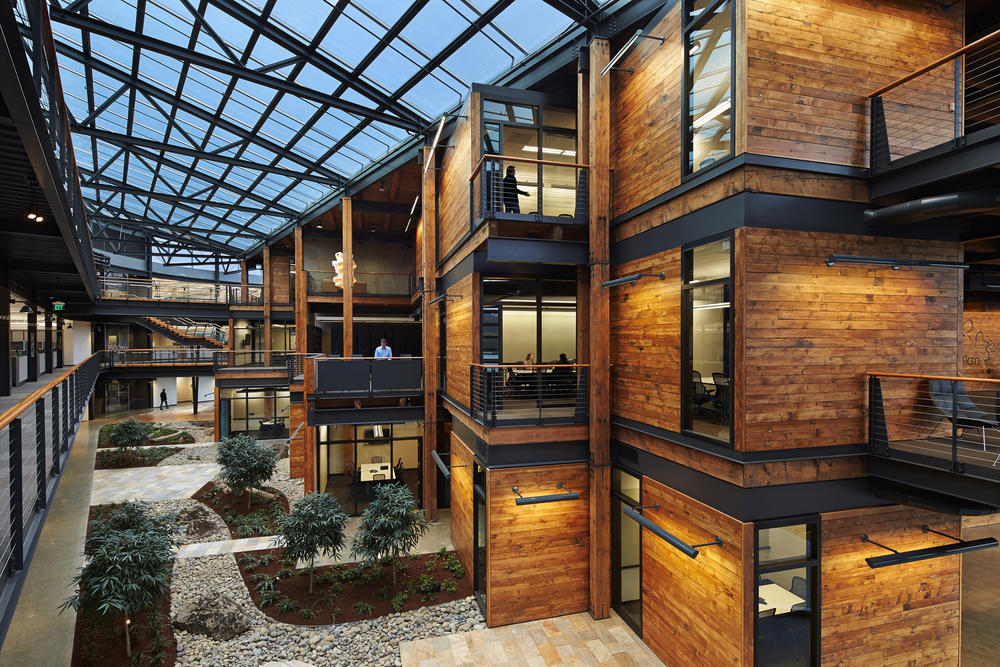
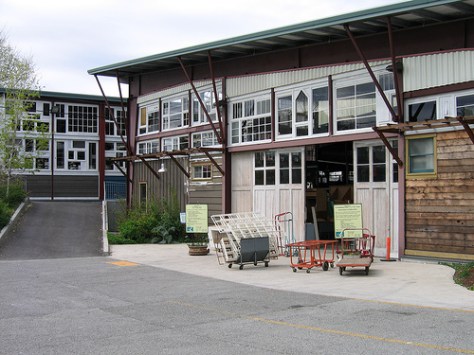
Seattle, Oregons’ Rebuilding Center, the largest by volume used materials centre in North America, is nearly 20 years old. The Centre contains a veritable treasure trove of all and every kind of used materials needed to build a home, from door-knobs to baths to the full scale steel joists.

Dedicated teams of Deconstructionists head out daily to dismantle, collect and retrieve materials from the city and it’s surroundings. Known as the DeConstruction Services these trained specialists dismantle anything from “a kitchen, to a full house, to a 100 year old grain mill.” Working by hand, this demolition by other means results in up to 85% of materials being reused.

Here’s one of the founders telling Rebuilding Center’s story.

The ReBuilding Center also includes the ReFind furniture workshop, which produce bespoke furniture and designs, including this recent local Portland yoga studio reception desk.

The ReBuilding Center’s Centre is designed by Communitecture.

Rebuilding Center building 1

ReIY – Reuse It Yourself

In Britain Reuse It Yourself  has been set up as a platform for developing a nationwide network of building material reuse centres, aiming to emulate Habitat for Humanity’s ReStores network. Based on the principles of the National Wood Recycling Centres and Furniture reuse projects, ReIY centres act as hubs to co-locate different enterprises and include training. These are social enterprises, which collect excess construction materials and sell them on.

ReIY note that Building Material Reuse Centre’s need space to work. A site of 10-20,000 sqft is needed to do a BMRC justice, smaller sites will only allow a limited product range to be undertaken.


Eco-Industrial Parks & Industrial Ecology

Eco-Industrious: One person’s waste is another’s raw materials

The idea of eco-industrial parks, zones, or districts has been around for quite a while, at least from the 1990’s. Based on industrial ecology, with the idea of designing industrial systems to behave like an ecological system.

Industrial Ecology is “principally concerned with the flows of materials and energy through systems at different scales, from products to factories and up to national and global levels.”

Industrial Symbiosis “focuses on these flows through networks of businesses and other organizations in local and regional economies as a means of approaching ecologically sustainable industrial development.”

Prof Marion Chertow 2004

Eco-Industrial Parks 

An Eco-Industrial Park “is a community of manufacturing and service businesses seeking enhanced environmental and economic performances through collaboration in managing environmental and resource issues including energy, water, materials …the community of businesses seeks a collective benefit that is greater that the sum of the individual benefits each company would realise if it optimized its individual performances.”

Lowe & Warren 1996

If Industrial Ecology is designed around optimising materials and energy flows, in Eco-Industrial Parks the flows of waste and energy are co-designed with a group or cluster of eco-industry businesses, working together to harness their optimum use, the industrial equivalent of an ecological system. At their most basic Eco-Industrial Parks involve exchanges between firms of their excess energy and materials. Waste from one firm becomes the raw material for another.

Four principles of Eco-Industrial Parks       

  • Industrial processes are linked systematically to reduce consumption of raw materials, water and energy.
  • Industrial waste can become raw material for linked businesses.
  • Businesses can be clustered in eco-industrial parks to reduce waste and transport costs while simplifying logistics
  • Expertise can be applied on a case-by-case basis

Daniel Wahl

There are various different ways in which Eco-Industrial Parks can be organised. Generally they comprise these three core elements:

  • Recycling businesses
  • Environmental technology companies
  • Businesses based around a single environmental theme (i.e. solar energy)

“Co-location is a key to optimising the synergistic and symbiotic whole systems design!”  Daniel Wahl

Types of Eco-Industrial Parks 

There are different types of Eco-Industrial Parks but all share various aspects including:

  • Co-location or proximity: A variety of companies which are clustered near to resource recovery and recycling facilities.
  • Shared byproducts:  Companies use waste energy and material from others as inputs in their own processes.
  • Cleaner production: An emphasis on cleaner production throughout the production process.

Source

Eco-Industrial Parks are also distinguished in the following ways:

  1. Eco-Industrial and Resource Recovery Parks
  2. Resource Recovery Park – A group of reuse, recycling, and composting processing, manufacturing, and retail businesses receiving and selling materials and products in one location.
  3. Zero-Emission Park – A group of co-located businesses working together to reduce or eliminate emissions and wastes.
  4. Virtual Eco-Park – A group of businesses that are geographically separate, but still working together to minimize their impact on the environment.

Eco-Industrial Parks Examples

 Although the “first and canonical example” of an Eco-Industrial Park originated in Europe – Kalundborg on Denmark’s Western coast – as an approach Eco-Industrial Parks have been more popular in the USA, and also in recent years have begun being developed in China. For examples of Eco-Industrial Parks from different parts of the planet click here.

Forssa Eco-Industrial Park – Finland

The Forssa Eco-Industrial Park, Finland is focused on ‘bio-economy’ fused with expertise in recycling. This includes the optimisation of large modern greenhouses and the production of green covers (sod turf), growth media and bio-fertilisers. Applying a closed loop cycle, materials and energy are linked to other industries in the eco-industrial park including biogas and biodiesel production for use as transport fuel, in utilisation of carbon dioxide separated from biogas, and in industrial aquaculture using bio-energy and the innovative utilisation of the by-products from the food industry.  At the core of the park is a comprehensive bio-refinery that diversely utilises different by-products of the food industry.

The Eco-Park is closely linked to the Forssa Envitech, which is a leading Finnish centre in glass recycling and is a significant national centre in the handling of electric and electronic scrap, contaminated soil and biowaste.

Forssa EIP graphicG