All posts by georgesinc

Rantasalmi wood materials Eco-Industrial Park – Finland

Rantasalmi, in mid-Finland is the site of Finland’s first wood materials industrial park, with waste wood powering the electricity plant, and its excess heat warming the cluster of on site wood businesses.

These include Finland’s fourth largest log house manufacturer, carpenters, a transport company and a window and door frame factory, which by operating side-by-side, provide their waste wood and sawdust to the plant. For a description see this pdf

Businesses at Rantasalmi aim to increase their collaboration over time, improving material and energy efficiency, reducing waste and limiting emissions. All businesses have agreed to and signed a common environmental policy.

Screen shot 2014-02-24 at 15.28.07

Monterey Regional Waste Management District – Marina, California, USA

The Monterey Regional Waste Management District Regional Environmental Park is both considered an Eco-Industrial Park and described as a prime example of a Resource Recovery Park. In 1991 it was recognised as the ‘best integrated waste management system’ in North America.

What might look to some like a mega recycling dump, has been carefully designed to optimise the waste which arrives by the hour, split into different groups such as the public drop-off recycling station and Last Chance Mercantile resale facility. Around 60% of the materials turned in to the Park’s Household Hazardous Waste collections, are reused by the community through a “drop and swap” programme, significantly reducing disposal costs.

A Materials Recovery Facility (MRF) processing more than 100,000 tonnes of community waste that arrives annually, with a 75% target for recycling and reuse. Significant amounts end up in the award winning Last Chance Mercantile, which then are sold back to the community.  Construction and demolition materials are sorted as is waste wood. There’s also a wide range of green products composting and soil blending facilities.

Monterey was one of the earliest adopters of landfill gas to electric energy in the States, with 5 megawatts of electricity generated annually. Two years ago a compost pilot demonstration project using SmartFerm anaerobic system is processing 5,000 tons of organic material per year.

If this isn’t the usual form that Eco-Industrial Parks are envisaged, it graphically shows the overlap between organising recycling waste and their more effective reuse.

MRWMD-Logo

ReVenture Park – Charlotte, North Carolina, USA

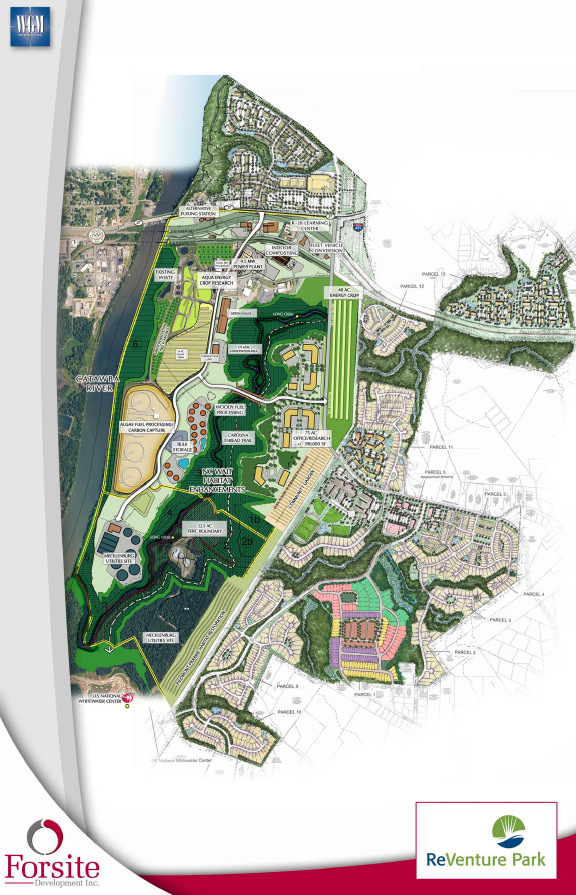
The ReVenture Park  is in the early stages of developing the largest US eco-Industrial Park of its type. Situated on a 700 acre site, ReVenture’s core plan is organised around a large renewable energy complex. Facilities for waste-to-energy power plant, wastewater treatment, solar energy fields, clean tech start-ups and R&D hub are to be developed inside and around an old textile dye factory – with half a million square feet of industrial space. Publicity states that a significant campus and educational aspect to the eco-development is part of the plan, with more than 1,100 “green collar” jobs being created.

Old already in place railway tracks, multiple electricity substations, transmission lines and a 360 million gallon containment pond add to the in-situ infrastructure for ReVenture. A portion of the extensive site is reserved for natural wildlife habitats.

Screen shot 2014-02-24 at 15.07.10

Hong Kong Eco-Park

At the Hong Kong Eco Park  a number of recycling firms co-exist side-by-side on a 20 hectares plot. The companies recycle a variety of waste materials such as cooking oils, wood, metals, electronics, plastics and batteries.

The Eco-Park is part eco-industrial centre and part recycling centre, with waste only being used for waste-conversion feedstocks and inputs for manufacturing. The varying companies don’t, however, involve exchanges of material or energy, but do share various other human and infrastructure resources to draw down environmental impacts. A brochure can be downloaded here

Hong Kong Eco-Park graphic

Intervale Eco-Park – Burlington, USA

Intervale Eco-Industrial Park is an agricultural and farming focused Eco-Industrial Park. Waste Heat from a Biomass Plant warms greenhouses for a mixture of local farms, and a community garden. Food waste from Burlington city is mixed with wastewater from the local Ben & Jerry’s ice cream plant (yes, Burlington is the home to Ben & Jerry’s!) which mulches into fertiliser, which is then used by both the Intervale and other farmers.

Intervale is a demonstration site for the first Living Machine, invented by biologist John Todd, as a natural water purifier. The water is treated using plants, cleaning a specific waste stream, using diverse communities of bacteria and other micro-organisms, algae, plants, trees, snails. The Living Machine is a good example of ecological engineering.

Intervale is also a core part of the community food system. According to Greener Ideal magazine: (article here)

“by integrating food production, processing, distribution and consumption, the park seeks to enhance the surrounding community’s social and economic well being while stewarding the environment and improving nutritional health.”

Intervale Eco Park Research paper by John Todd here

Intervale integrated design 1

Kalundborg, Denmark

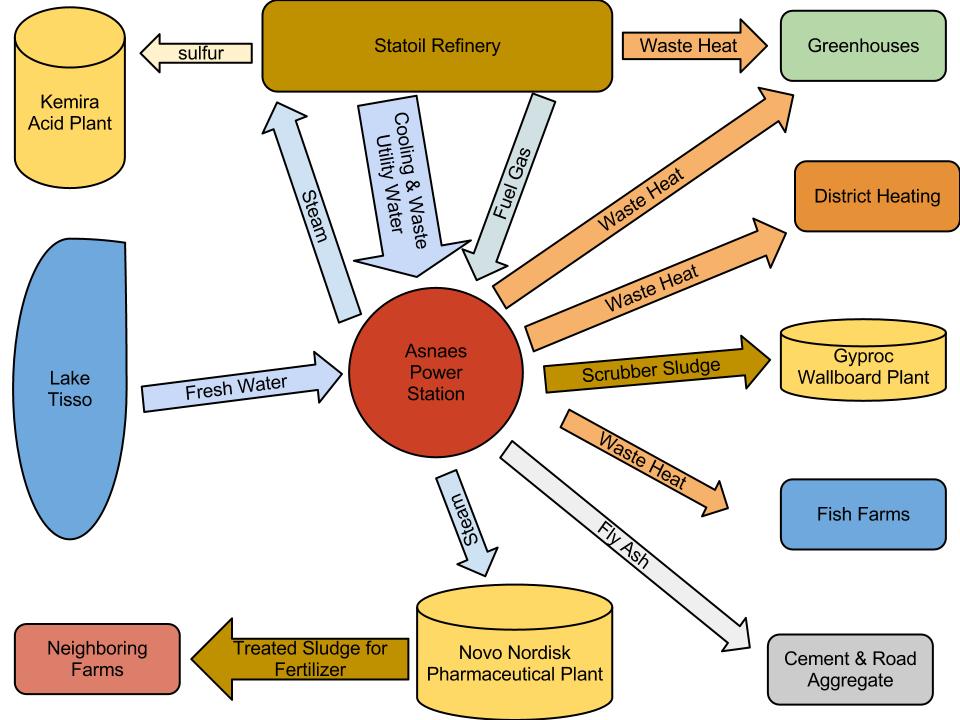
Kalundenborg in Denmark, is one of the best-known (and one of the oldest) examples of an industrial ecology in action. Different companies at Kalundenberg use each others waste.

For instance Kalundborg’s power plant produces various materials and energy flows; gypsum which then is used to produce plasterboard, and steam, which warms fish farming ponds. In turn sludge from the fish-ponds and factories fertilise local farms.

Kalundborg_Eco-Industrial_Park_Symbiosis_Map

The Green Hall (Den Grønne Hal) Christiania – Copenhagen, Denmark

The Green Hall is in one of the buildings located in Christiania Freetown, an icon of hippie life in Copenhagen. Alongside a fantastic variety of self-built homes, the Green Hall is a multi-purpose timber shed, housing a recycling centre where Christiania residents can get the most of their building material. Also doubling as a craft centre for kids, and an evening concert hall.

While not solely a buildings materials resource centre, nor focused on reused materials, the Green Hall integrates these into its wider alternative supermarket, with new as well as re-cycled materials available alongside fuel, hardware, office supplies, work clothes, hobby materials, sewing materials, used clothes, Christiania merchandise re-cycled furniture and much more.

hallen

Almere – Netherlands

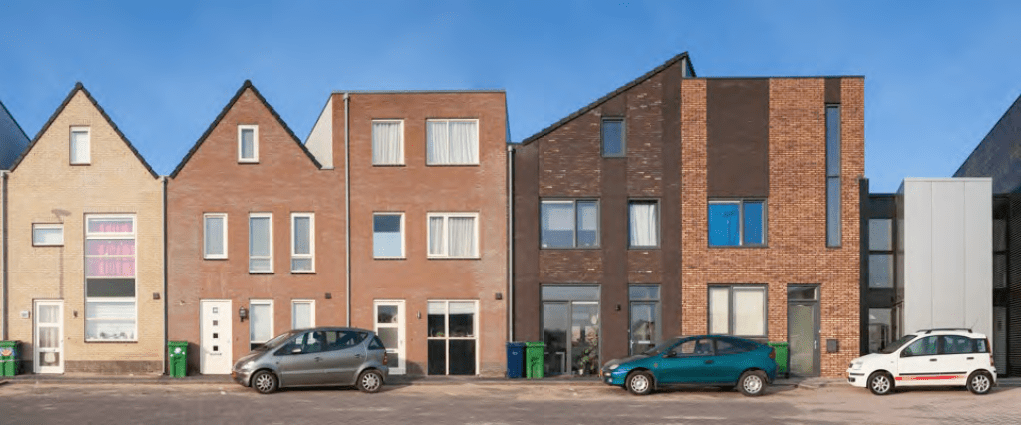
The Netherlands Almere is a Dutch new town of slightly under 200,000 standing on reclaimed land thirty minutes from Amsterdam. The site also contains Europe’s largest self-build programme consisting of a 350 acre site to the south west of the town. Master planned into a number of districts, each of which has around 720 self-build plots, with over 1000 homes already built, and an eventual 3,000 self built homes planned. This self-build city was announced The Almere Principles, a strategic policy shift in 2006, and is being closely watched by other European housing policy ministries, including the current UK Coalition administration. This local government document can be found here.

A Guardian article on the Almere phenomenon in the British context can be found here.


Segal Method

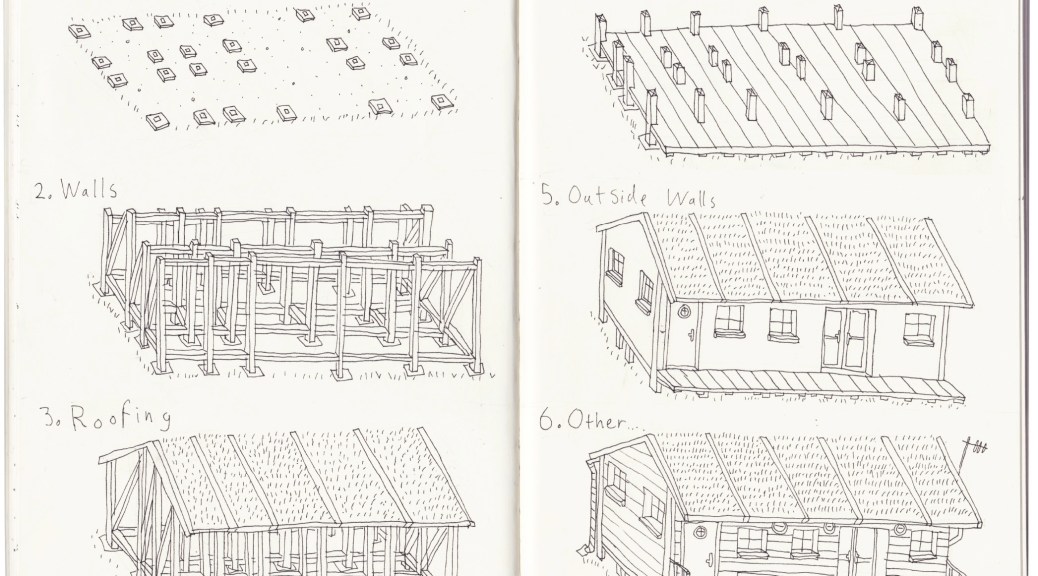
Walter Segal, a German émigré architect who settled in Britain, developed the Segal Method of timber construction to help enable cheap timber buildings to be constructed by non-professional self builders. The early projects were mainly in Lewisham, South London and the Walter Segal Self Build Trust continues to promote the approach to the public. A number of projects can be found on their website here.

Ashley Vale – Bristol, Uk

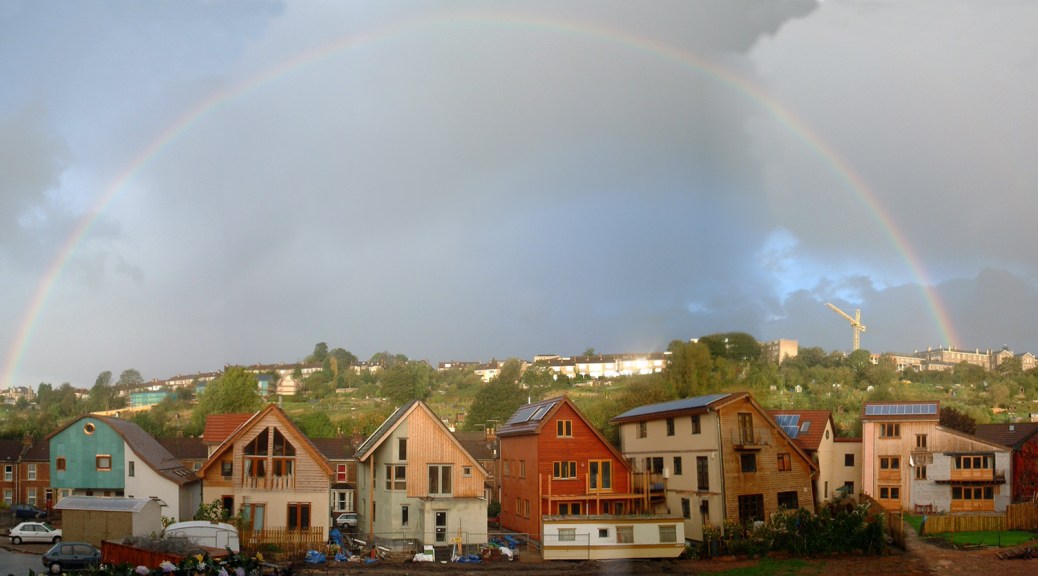
Ashley Vale is a community and self-build eco district in the heart of Bristol. Taking nearly fifteen years to complete, Ashley Vale consists of 17 buildings, all of which are self built by the community. The resulting buildings are diverse, and demonstrate a completely non-doctrinaire aesthetic, which is both individual and inspiring. Ashley Vale illustrates where self-build can be taken if the community are committed to and engaged with the process of self-build. For more information on community-self build projects in and around Bristol, visit the Bristol Community Land Trust.

 Ashley Vale is also where a number of national self-build organisations are based.