
Lancaster Co-Housing is the first Passivhaus Co-Housing project in Britain. Standing beside the river Lune, outside the North Western town of Lancaster, the 2.5 acre site comprises 41 homes, all of which attain code 6 for Sustainable Home standard. Designed by Ecoarc the project also includes community facility’s, workshops, offices and studios in a redesigned mill. Lancaster Co-Housing demonstrates the Passivhaus system being put to use for community ends.
All posts by georgesinc

LILAC Affordable Ecological Co-Housing Project – Leeds, Uk
LILAC stands for Low Impact Living Affordable Community. LILAC recently opened after several years preparatory and participatory work. Six varyingly scaled block houses are home to the first 21 LILAC residents, living in this inner-city and contemporary version of Co-Housing localism in Leeds. The LILAC site includes allotments, community and individual gardens and is considered a pioneering example of new style community localism.
LILAC has been designed through community participation with the Bristol practice, White Design. The Low Energy housing uses ModCell straw bale cassettes and structural cross laminated timber, two cutting edge ‘bio-based’ building materials. See here.

Vauban – Freiburg, Germany
Vauban is one of the earliest continental eco-districts, which developed in the 1990s and early 2000s into one of the most ambitious housing project on the continent. Vauban was originally a response to the Chernobyl Nuclear Power disaster in 1986, with its early stages of creation driven by a community of environmentalists working to develop sustainable approaches to living.
Today Vauban, on the site of a one time French military barracks at the edge of South West city, Freiburg, is one of Germany’s prime examples of a leading edge eco-district and is known across the housing and planning world. With over 5000 residents, Vauban is one of the few eco-districts which demonstrates, showcases and provides an exemplar of large-scale low energy living, while retaining a strong community ethos. The main central part of the eco-district, with a tram line running down its central spine, is car-free, with interlinking pedestrian and cycle paths connecting much of the housing, significant tree cover, and natural features (including boulders and large stones) acting as nature playgrounds for children, and gardening areas for adults. Schools, health-centres, whole and organic food stores are part of the wider eco-district.
Vauban is a pioneering example of how eco-district and community can be co-created for the ecological future.

Hammarby Sjostad – Stockholm, Sweden
The second major Swedish eco-district project is Hammarby Sjostad in Stockholm. When first initiated in 1990 the aim of this large eco-district (planned 25 000 inhabitants in 2015) was to cut overall impacts by half, to be delivered using the Eco-Cycle or Hammarby model. A set of current objectives, for instance 80% of travel by public transport, are set to be reached by next year.

Bo01 – Malmo, Sweeden
Bo01 – Malmo. Those watching the Danish-Swedish TV thriller ‘The Bridge will likely know where Malmo is, (the other side of the Bridge from Copenhagen.) What isn’t apparent from tv is the Bo01 eco-district along Malmo’s old dockland harbour front.
Opened in 1998, and showcased in a housing fair in 2001, Bo01 has grown in the intervening decade. Bo01 is a showcase for integrating many aspects of sustainable building culture on a large scale, and has become a major influence on the development of green cities world-wide. On this wider agenda see here.
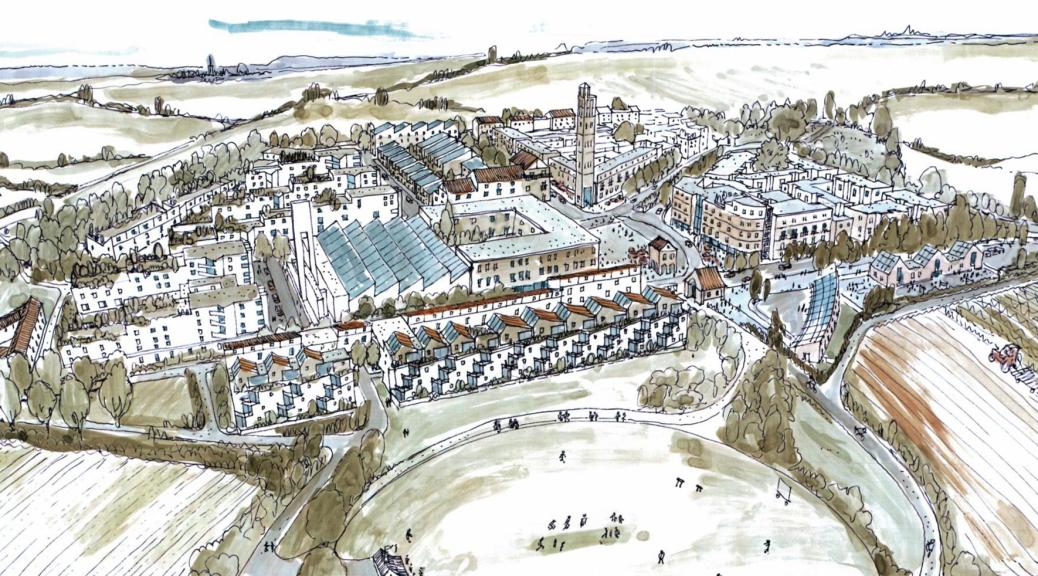
North West Cambridge – Cambridge, Uk
North West Cambridge – This major development on 150 acres of University of Cambridge owned farmland, was granted planning permission in 2013. The website claims “the development will be an exemplar of sustainable living, with residential dwellings built to the Code for Sustainable Homes Level 5 and non-residential homes will be BREEAM Excellent,” and includes use of water management, energy and waste systems, and a Green Travel plan “to encourage residents and neighbours to lead sustainable lives.”
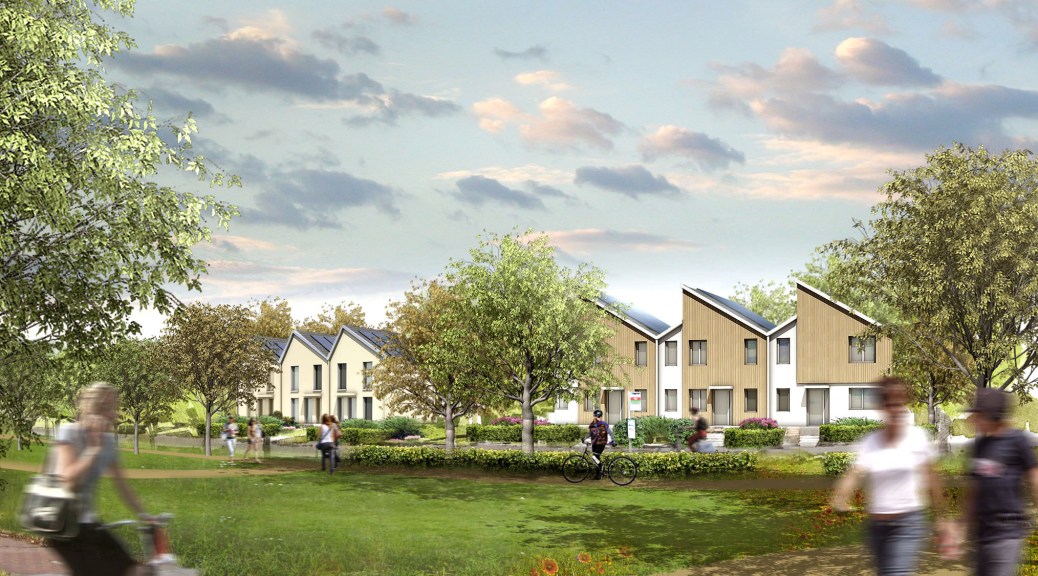
North West Bicester – Oxfordshire, UK
North West Bicester is the one remaining live Eco-Town that has survived since New Labour originally announced the Eco-Towns programme in 2008 (down from a mooted 20 and a firm starting point of 10.) North West Bicester first phase is to be presented to planning in spring 2014, and is being designed to BioRegional’s One Planet Living’ Principles, with Zero Carbon housing. The website states that the first phase will feature allotments, fruit trees and landscape led play areas.

The Triangle – Swindon, Uk
The Triangle, Swindon is TV Personality’s Kevin McCloud’s pitch at a ‘high quality sustainable development’ of forty-two homes. The Triangle applies BioRegional’s One Planet Living methodology to the housing, but as Mel Starrs points out in an interesting blog entry, it is by no means clear what sustainable code level has been attained.
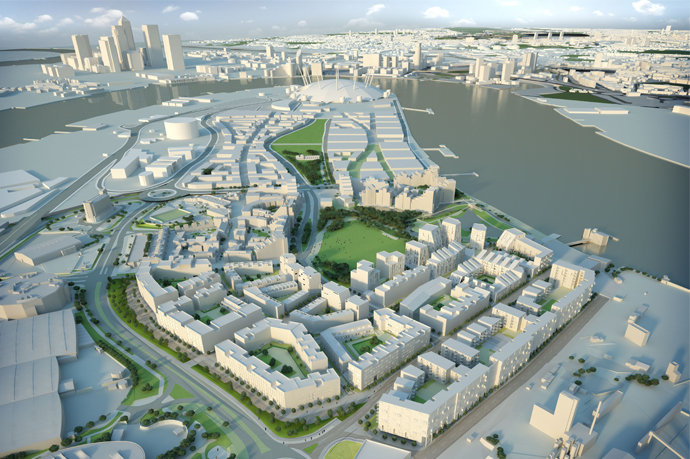
Greenwich Millennium Village – London, Uk
Greenwich Millennium Village was a major showcase eco-district development planned alongside the Millennium Dome (now the 02) as part of the Millennium Communities Programme. The eco-district aimed to reduce primary energy use by 80% and has been gradually growing in the decade and half since the turn of the century, with, as of 2010 over 1100 flats and houses.
PortZEd – Shoreham, UK
PortZED is a current ZedFactory project in collaboration with Alan Parker Architects, a zero carbon development in Shoreham, which received planning in December 2013. The Developers are Boho Green.
 Making Lewes