All posts by georgesinc

MAKING PLACES SUMMER 2014!

This second series expands and extends MakingPlaces’s first talks series from leading figures in the fields of sustainability and architecture into waste, natural and local materials, making, remaking and re-use.

Duncan Baker-Brown – 26th June, 7.30pm – Elephant & Castle*

Duncan Baker-Brown, one half of the founders of Lewes’s own
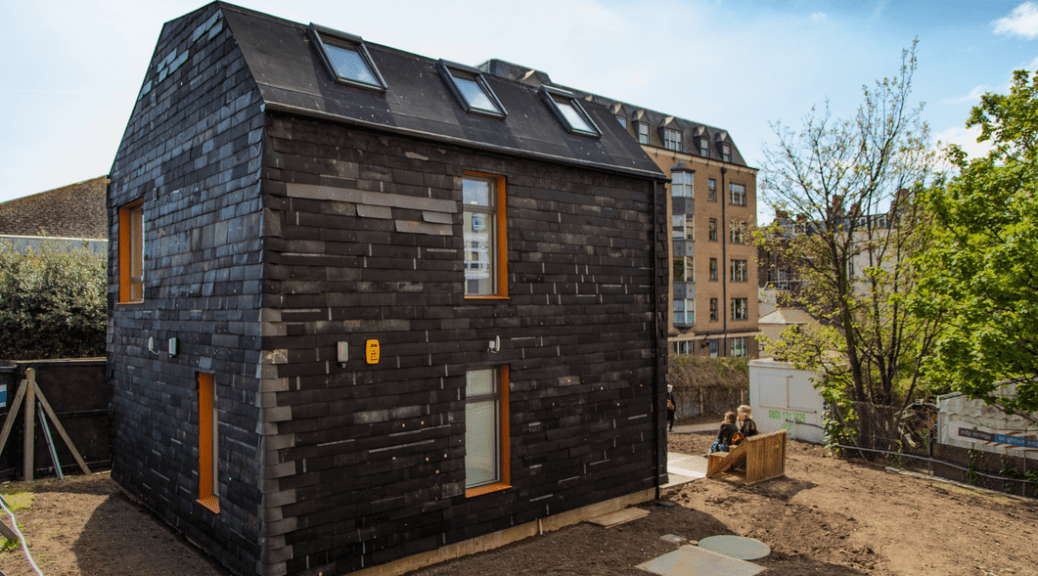
BBM Sustainable Design, will talk about the practice’s Wastehouse collaboration with Brighton University. The Wastehouse has been made almost completely out of second hand re-used materials, including, for instance, 20 000 toothbrushes! Duncan will talk about how the planet of waste could become common place in building culture, and compare re-use, recycling, and upcycling with natural renewable materials.

* The talks take place in the upstairs events room of the pub (map here). Drinks available at the bar, suggested donation £3.00.

For information on all three talks download the pdf makingplaces.summer2014poster


Green Roofs – Gardens in the Sky

Green roofs have become increasingly popular in the last years, seen as an easy and accessible way to add ecological value to building projects. When in full bloom, as well as many other times in the year, green roofs can also make a world of difference, turning grey into vibrant colourful cityscape rooflines, acting as air pollution filters, absorbing water run-off, and easing temperatures.

On the continent, particularly in the German-speaking world (Germany, Austria and Switzerland), green roofs have long been part of the roofed landscape, first developing in the 70’s and 80’s. More recently the US, Canada, Japan and Singapore have seen a sharp uptake in green roofs. In Germany by 2001 over 40% of councils were offering incentives for green roofs. By comparison Britain has been slower to take on green roofs, although interest has grown in recent years. One estimate concluded there was 200 million square metres of roof-space that could be adopted to green roof use with either no or only small changes needed.

Primary benefits

There are various benefits to green roofs, with primary environmental benefits including:

  • Reducing rain and storm water run-off, generally in tandem with a sustainable urban drainage system
  • Reducing energy use: green roof improves insulation and lessens energy requirements
  • Increasing biodiversity:  with less and less ‘on ground’ suitable habitats, green roofs can mimic some biodiversity habitats and needs
  • Improving air quality and improving water quality: can help remove airborne particles, heavy metals and volatile organic compounds from the local atmosphere, which also helps with water quality.
  • Creating a more pleasant environment, particularly in densely populated and built upon urban areas, without sizeable open green spaces
  • Helping to mitigate climate change; plants hold moisture, and provide bulk to moderate temperature changes
  • In cities green roofs can reduce what’s called the Urban Heat Island Effect. Where there is extensive built fabric, i.e. cities, solar heat gets stored up in the city fabric overnight and while released when temperature falls, will raise the average temperature by a mean average of 4 degrees compared to temperatures in the countryside.

Main structural green roof elements and types

As a starting point green roofs require a waterproof membrane between the roof and the earth substrate. Beyond this the depth and design of green roofs are quite diverse, ranging from lightweight and superlight (12 mm drainage board), extensive (less than 100 mm) and intensive (over 200 mm.)

Main green roof types

Mat-Based, (consisting of pre-grown mats of sedum or meadow flowers placed on water retentive material/substrate) Substrate based, (growing layers supporting plants) and biodiverse and wildlife (locally sourced aggregates and natural features from which specifically chosen flora and fauna grow.) Further info on different roof types, best practice etc here.

Main plants used in green roofs

Vegetation and plant choices are critical, requiring tough, hardy and long living plants. Sedum is the archetypal green roof plant as it is very draught resistant. However it has gained a mixed reputation as it has been widely used (or abused) on super thin substrate green roofs that contain very low-diversity and poor plant growth. Herbaceous flowering plants, grasses and an increasing interest and use of native wild flowers. Further information here.

This information has been partially taken from the Green Roof Guide, an invaluable source of authoritative guidance on green roofs in the UK climate and environment.

Further short cuts to green roof guidance:

 Design

Construction Practice

Wildlife Green Roof Guidance
Sheffield bus stop green roofs

2 Sheffield 2 Bus Shelter

In collaboration with Sheffield Groundworks, Sheffield City Council have installed green roofs on a number of the roofs of bus shelters across the city. Those who have visited the city will know what a concrete jungle parts of the city are, with bus shelters bringing rare greenery to the gritty urban environment while also acting as filters to air pollution from traffic exhaust. Might this not be taken a few stages further?


Sharrow School, Sheffield


1 Sharrow School Green Roof 1

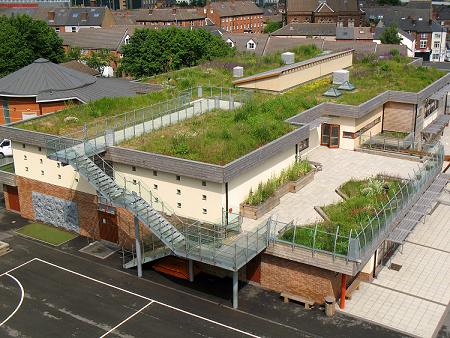
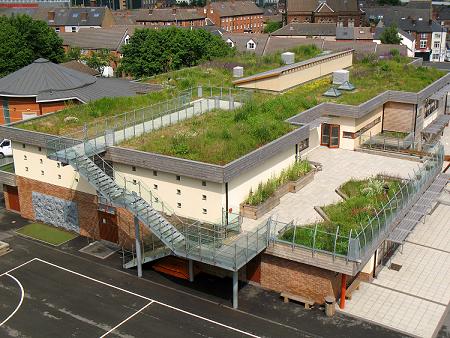
Sharrow School, close to the city centre, features one of the most ambitious green roof projects in the country. Sharrow is on a sloping hill and the new primary school (as of 2009) was designed to be on several levels, and therefore several roof layers, which double up as outdoor learning spaces and green roofs. The 2000sq metres of multi-level roofs contain a number of habitats, from Peak District limestone grassland, wildflower meadows, urban brownfield sites to a wetland area with a small pond. The roofs have been the first in the country to be granted local nature reserve status.

Dalston Roof Park

5 Dalston Roof Park 1 film club

One of north London’s more recent hipsters quarters, Dalston, mixes a fair share of bubbling creative activities with serious social challenges. Dalston Roof Park  has been set up for three years in Ashton Street,  (possibly twinned with Lewes’s former Socialist Republic of Leicester Road) as a social enterprise atop a mixed-use workspace building to be used for all sorts of social and community activities, from open-air movies in bed (I kid you not!) community bake offs, local company’s product launches, and music and party type activities.5 Dalston Roof Park 2 garden

The Muse – Bere Architects

4 Bere green roof 2

The Muse has been until recently the work studio for Bere Architects, and remains home to its founder, Justin Bere. While Bere, the architect, and Bere the practice have become known as leading advocates of the Passivhaus approach to zero energy design, the building they work from has also been featured as one of the most attractive and photogenic roof garden projects in London, earning features in the National Geographic. Bere, (in the architectural mode) has created a fantastic roof garden within a very tight urban space round the back of Islington Square.4 Bere Green roof 1

Materials Reuse & Reuse Centres

Building Materials Reuse

“The British construction industry is the largest single sector consumer of resources and producer of waste, annually consuming 400 million tonnes and producing 86.7 million tonnes of waste, almost 40% of the country’s total. This is equivalent of 7 tonnes of material per person; enough for 40, 000 new homes. In addition the industry comprises 19% of our ecological footprint, 23% of our GHG emissions and 30% of all road freight in the UK, whilst the total spend on product and materials is estimated around £30 billion a year.”

From An investigation into the viability of Building Materials Reuse Centres – MSC by Andrew Edwards, Oxford Brookes University.

As the above quote notes the building sector single-handedly creates the largest amount of waste in the country. While figures vary in different countries, these sorts of numbers are not exceptional. In terms of carbon the industry accounts for about 10% of the UK’s total CO2 emissions. The potential to reuse materials in multiple ways is however beginning to be acknowledged and there are a variety of approaches across the mainstream of the industry as well as its forward looking edges, which look as if they are beginning to be taken more seriously.

Building Materials Reuse Centres

Building Materials Reuse Centres (BMRC’s) are a North American import. The centres aim is to reduce the environmental impact of buildings by reusing materials and building products. When buildings are renovated, rebuilt or demolished the place to take the now redundant materials are BMRC’s, so they can continue to be reused rather than head for the tip. Reuse is the other end for materials of a journey that begins with extraction or the first processes of being turned into products/buildings.They continue and extend the lives of these materials and products a number of times.

The Centres (BMRC’s) come in various shapes and sizes but the core idea is common to all, a central hub for building materials, which can be re-used in other buildings. The community version is more established than exemplars for the construction industry; there is indeed much to be learnt from what examples are in place across the community sector in various different countries.

Beyond the simple adaptation of the second hand store, there is the potential of developing integrated networks, which could refine the ecology of building material needs. Even if well developed in the imagination of some BMRC’s theorists, this doesn’t appear to be quite beginning as yet.

Follow these links for examples of Building Materials Reuse and Building Materials Reuse Centres.

The Green Roof Centre – Sheffield leads the way!

1 Sharrow School Green Roof 1


In Britain, the midlands city of Sheffield is at the forefront of developments with green roofs. Planning rules for the city require all new buildings over 1000 square metres, or more than ten houses, to integrate 80% of vegetated cover. Policy and initiatives have been influenced by the Green Roof Centre, which is part of Sheffield University’s Landscape Architecture department. The Centre has been conducting green roof experiments for the past decade, including Sharrow school, (pictured) and several of the rooftops of the university’s new buildings, as well as on various other buildings across South Yorkshire. To date there are over a 120 green roof building projects in the one time steel city.

MAKING PLACES SPRING 2014!

Join us in our first public event! Making Places  is a series of talks from leading figures in the fields of architecture sustainability and urban design, taking places in Lewes at the Elephant and Castle Pub.

Sarah Wigglesworth – 23rd May 2014. 7pm, Elephant & Castle

Stock000000-Orchard-Street-Islington


The third talk in the initial series of Making Places is from Sarah Wigglesworth.

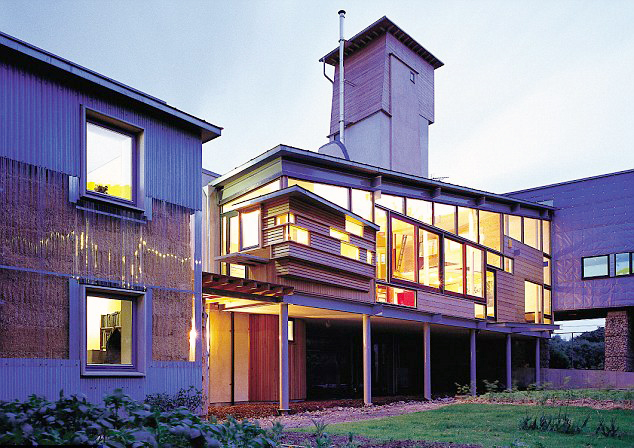
Sarah Wigglesworth Architects are well known for their experimental use and reuse of materials. Sarah’s home and studio, 9/10 Stock Orchard Street, is the first ever contemporary example of an inner-city straw-bale building. Sarah will talk about this and other examples of upcycling and recycling of buildings and materials across a variety of contexts.

For more info please download the pdf here:makingplaces2014.v1

MAKERS DIRECTORY COMING SOON……

Making Lewes is in the process of compiling a directory of makers from Lewes and surrounding areas.

Lewes has a wealth of creative talent, with crafts people, artisans, artists and makers of much variety occupying spaces throughout the town and surrounding countryside.

Part of the agenda for Making Lewes is to highlight and celebrate the Makers of Lewes. Check Back here soon…!

Above image: Annemarie O’Sullivan